If you shop for antique jewelry, you'll run into three diamond cuts again and again: the old mine cut, the old European cut, and the rose cut. They show up in Georgian, Victorian, Edwardian, and Art Deco pieces, and each one was shaped by hand long before the modern round brilliant came along.
Each cut has its own look. A rose cut has a flat back and a dome of triangular facets on top. An old mine cut is squarish with rounded corners and sits tall, and when you look straight down you can often see a small dot at its center. An old European cut has the same tall build in a round shape.
Every original stone was cut generations ago, so the supply is limited, and many were recut into modern shapes during the 20th century. Here's how to tell the three apart and what to look for before you buy an antique engagement ring set with one.
Antique diamond cuts at a glance
|
|
Rose cut |
Old mine cut |
Old European cut |
|
Outline |
Round, oval, pear, or irregular |
Squarish with rounded corners |
Round |
|
Main era |
1500s into the 1800s |
1700s to the late 1800s |
About 1870s to 1930s |
|
Facets |
3 to 24, all on top |
Usually 58 |
Usually 58 |
|
Underside |
Flat, no pavilion |
Deep pavilion |
Deep pavilion |
|
Top |
Faceted dome, no table |
Small table, high crown |
Small table, high crown |
|
Culet |
None |
Large, often visible as a dot |
Large, visible as a small circle |
|
In the light |
Soft glow with wide, mirror-like flashes |
Warm, broad flashes |
Bold flashes of color |
|
Face-up size for its weight |
Large |
Smaller than a modern round |
Smaller than a modern round |
|
Where you see it |
Georgian and Victorian clusters, accent stones |
Georgian and Victorian solitaires and clusters |
Edwardian and Art Deco engagement rings |
Why antique diamonds look different from modern diamonds
For most of history, diamonds were cut by hand. Cutters worked by eye, and rough diamonds were rare and expensive, so the priority was keeping as much of the stone's weight as possible. They followed the natural shape of each crystal, which is why antique diamonds are rarely perfectly round or perfectly square.
Lighting played a part too. Before electric light, people wore their jewelry by candles and gas lamps. Antique cuts handle that soft, low light well, throwing off broad flashes of white and color that stand out in a dim room.
The modern round brilliant cut diamond you see in most engagement rings today came along much later. In 1919, Marcel Tolkowsky published proportions for the round brilliant that balance white sparkle with colorful fire, and new cutting machines made those proportions easy to repeat. By the 1950s, the round brilliant looked much like it does today. Side by side, a modern round looks brighter and more uniform, while an antique diamond gives off bigger flashes and shows small signs of hand cutting. Many of our buyers love antique cuts for exactly that reason.
When you shop for a modern diamond, you'll often see a cut grade like "Excellent" on its GIA report. GIA began adding those grades in 2006, and they only apply to modern round diamonds. Old mine and old European cut diamonds were cut long before that system existed, so their reports won't list a cut grade. That's expected and says nothing bad about the stone. To judge an antique cut, look at its color, clarity, condition, and how it looks in person.
What is a rose cut diamond?
A rose cut diamond has a flat base and a domed top covered in triangular facets that rise to a point, a shape that early cutters thought resembled an opening rosebud. Because it has no deep bottom half, it gives a soft glow and wide, glassy flashes as it moves.

How to recognize a rose cut
- A flat back. Look at the stone from the side; it sits low, with no point below.
- A faceted dome with no table. There's no flat facet on top, only triangular facets meeting at the peak.
- Between 3 and 24 facets. A traditional full rose cut has 24.
- A clear view into the stone. Because light passes straight through, rose cuts often look like a small window.
The outline varies. Rose cuts were made round, oval, pear-shaped, and in irregular shapes that followed the rough.
When rose cuts were made
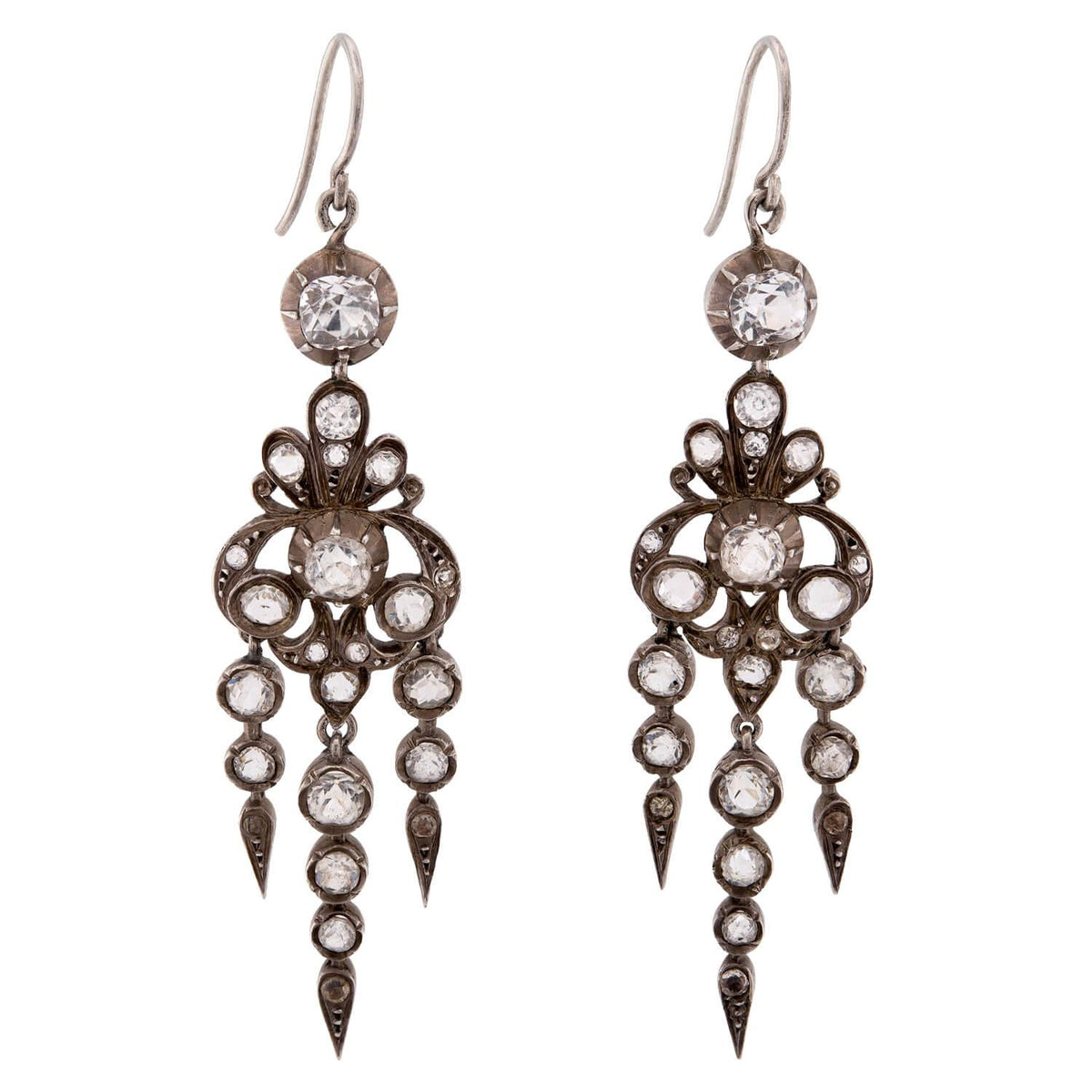
The rose cut appeared in the 1500s and remained the standard cut for small diamonds through the Georgian era and into the Victorian era. You will find rose cuts in cluster rings, mourning rings, and as accent stones around a larger center. In many Georgian pieces they were set in closed backs lined with foil to brighten them.

What is a double rose cut?
A double rose cut is two faceted domes joined back to back, with no flat side. It was used for pendants and earrings where both sides of the stone could be seen.
Browse our rose cut diamond rings or explore Georgian rings, where rose cuts appear most often.
What is an old mine cut diamond?
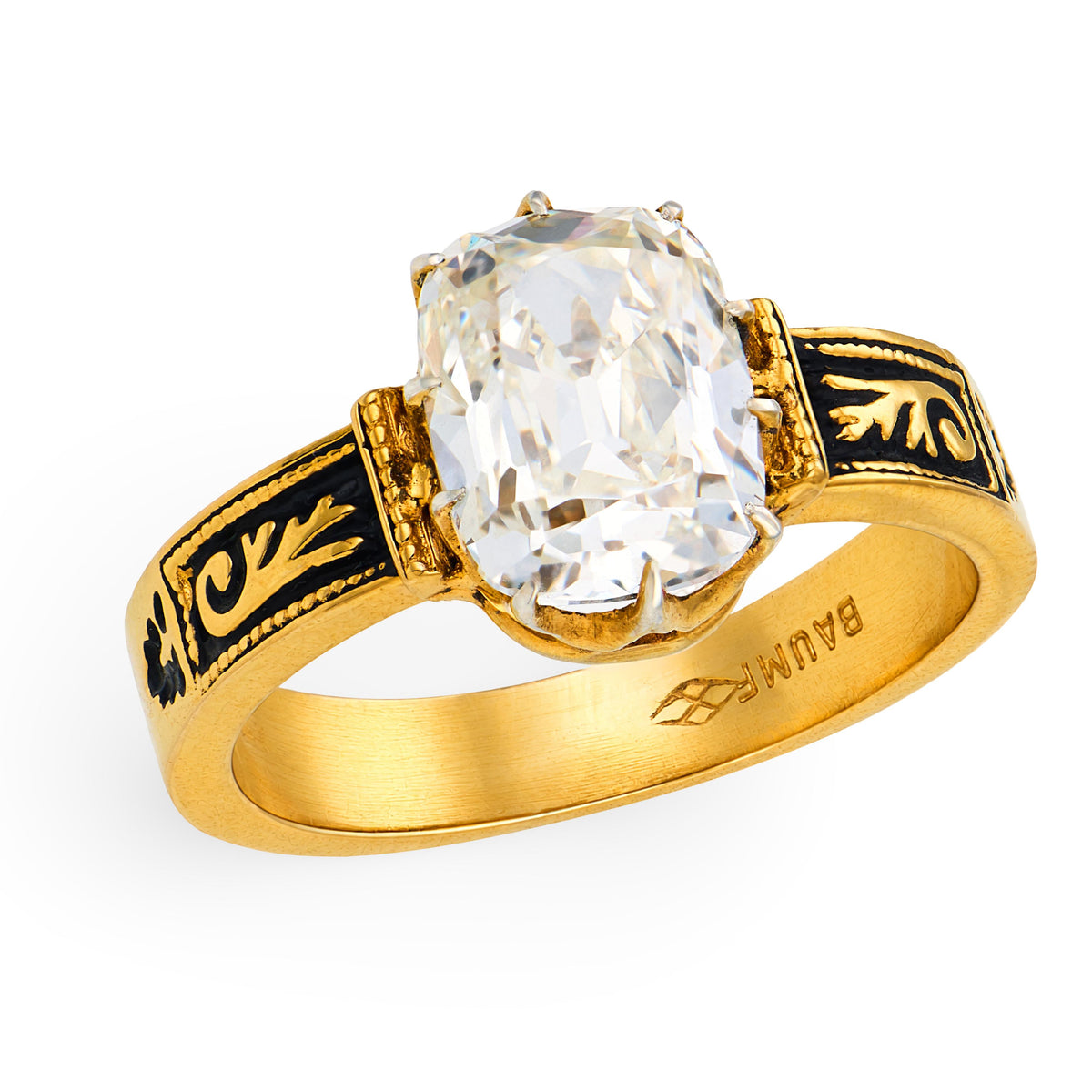
An old mine cut diamond is a hand-cut antique diamond with a square shape and softly rounded corners. It sits tall, with a small flat top and a tiny flat facet at the bottom that you can often see through the stone. It was the most popular diamond shape from the early 1700s until about the 1880s, when the round old European cut took over.

How to recognize an old mine cut
- The outline is squarish with soft, rounded corners, and it is often a little uneven from side to side.
- The flat top is small and the stone sits tall. Seen from the side, the top of the stone rises noticeably above the setting.
- The culet is open. Look straight down through the top and you'll often see a small dark dot at the center. That dot is the flat facet at the bottom of the stone, cut there to protect the point from chipping.
- The flashes are broad. Large facets throw big, chunky flashes of white and colored light.
- The bottom half is deep, so a good share of the stone's weight sits below the setting where you can't see it.
Where the name comes from
"Old mine" refers to the original diamond sources of India and Brazil. These were the world's main supply until the large South African discoveries of the late 1860s and 1870s, and stones cut from that earlier rough became known as old mine diamonds. The squarish shape follows the natural eight-sided diamond crystal, which let cutters keep more weight.
Old mine cut vs. antique cushion cut
You will see "old mine cut," "old mine brilliant," and "antique cushion cut" used for largely the same stone. Some dealers reserve "old cushion" for stones with a more rectangular outline. A modern cushion cut is a different stone: it has a larger table, a pointed or very small culet, sharp symmetry, and often extra facets that create a "crushed ice" look.
To see these traits on real stones, browse our old mine cut engagement rings and look for the squared-off outline and small dot at the center in the close-up photos.
What is an old European cut diamond?
An old European cut diamond is round, which is the quickest way to tell it from the squarish old mine cut that came before it. Look at one face up, and you'll see broad flashes of light spreading out from a small dot in the center, often with bursts of rainbow color. It was the most popular diamond cut from about the 1880s into the 1930s.

How to recognize an old European cut
- A round outline, close to circular but rarely as exact as a modern round
- 58 facets, with short facets on the bottom half that create large, distinct flashes
- A circular open culet you can usually see as a small round spot through the top
- Strong fire, meaning bold flashes of rainbow color, especially under a single light source
When old European cuts were made
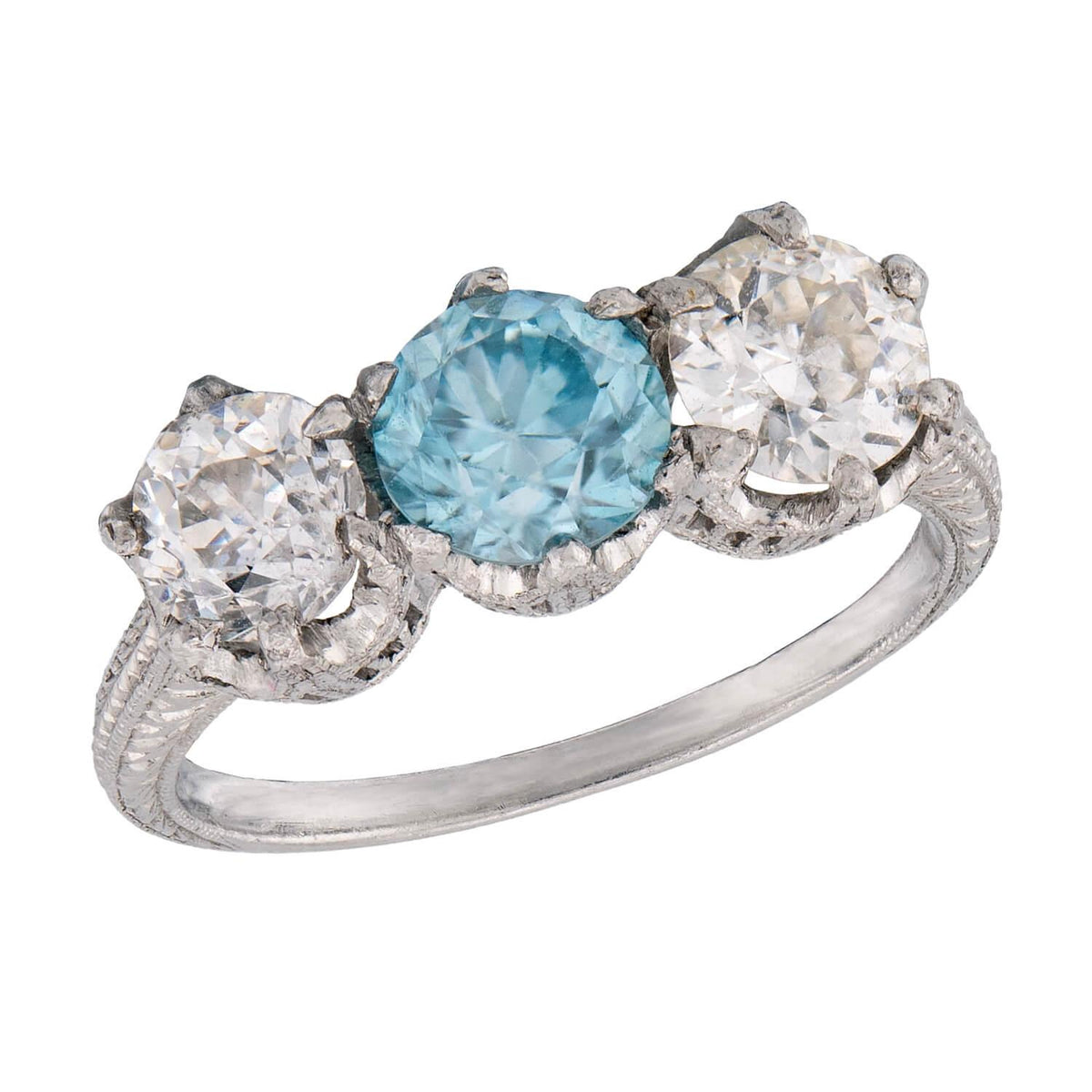
Two changes in the late 1800s made the old European cut possible. Huge diamond discoveries in South Africa gave cutters far more uncut stones to work with, and new machines let cutters grind a diamond's edge into a true circle. The old European cut is the typical center stone in Edwardian engagement rings and many early Art Deco rings, often set in platinum with small rose cut accents.
Old European cut vs. Modern round brilliant
|
|
Modern round brilliant |
Old European cut |
|
Table |
Small, often less than half the stone's width |
Larger, usually more than half |
|
Crown |
Tall |
Lower |
|
Culet |
Open, visible as a small circle |
Pointed or very small |
|
Bottom facets |
Short, so flashes are large |
Long, so sparkle is fine and even |
|
Look |
Bold color flashes, visible facets |
Bright white sparkle, highly uniform |
Which one you prefer comes down to taste. A modern round is cut for maximum brightness, while an old European cut plays with light in a softer, more varied way.
What is a transitional cut diamond?
A transitional cut diamond is a round diamond from about the 1930s to the 1950s, when cutters were moving toward the modern round brilliant. Compared with an old European cut, it has a bigger flat top and a smaller dot at the bottom, so it sparkles a bit more like a modern diamond while still looking vintage. You'll often see them listed alongside old European cuts.
Old European cuts look especially good in the lacy platinum settings of the Edwardian era and the bold geometric designs of the Art Deco years. Browse our old European cut engagement rings, or shop by era with our Edwardian rings and Art Deco engagement rings.
Old mine cut vs. old European cut: how to tell them apart
Old mine and old European cuts can look almost the same at first glance. Both have a small flat top, a tall upper half, a deep bottom, and a tiny flat facet at the base that you can often see through the stone. So how do you tell them apart? Start with the shape, then look at the bottom of the stone. All you need is a 10x jeweler's loupe and some daylight.
- Look at the shape. If the stone looks like a square with soft, rounded corners, it's an old mine cut. If it's round, it's an old European cut.
- Look down through the top. You'll usually see a small dark spot in the center. That's the culet, the tiny flat facet at the bottom of the stone. On an old mine cut it tends to be bigger and sometimes a little off center. On an old European cut it's usually a neat circle right in the middle.
- Look at the facets. Old mine cuts were shaped entirely by hand, so their facets vary in size and spacing. Old European facets look more even.
- Look from the side. Both stones sit tall, but an old mine cut often rises a little higher and looks chunkier.
Some diamonds fall somewhere in between. A late old mine cut can be almost round, and an early old European cut can be slightly square, so you may see the same stone called either name depending on the dealer. If you find one of these, don't worry too much about the label. What matters is whether you love the way it looks.
Which antique diamond cut is right for you?
The right cut depends on the look you want, how large you want the stone to appear, and how you plan to wear it.
Start with the look
- Rose cut: a low, soft glow with mirror-like flashes. Quiet and romantic, and it looks unmistakably antique.
- Old mine cut: warm, chunky flashes in a cushion shape, with the small irregularities that show it was cut by hand.
- Old European cut: the liveliest of the three, with bold flashes of color in a classic round shape.
If you can, see them in person. The differences are much easier to judge on the hand than in photos.
Compare face-up size, not carat weight alone
Old mine and old European cuts carry much of their weight below the setting. A one-carat old European cut can look smaller from the top than a one-carat modern round. A rose cut does the opposite and spreads its weight across the surface. When you compare stones, ask for the millimeter measurements of the face-up diameter, since that's what you'll see when the ring is on. Antique stones were also cut and set by hand long before standardized measuring, so listed carat weights are usually estimates.
Think about everyday wear
All diamonds share the same hardness, but shape affects how a stone handles knocks. The thin edge of a rose cut is the most vulnerable, while old mine and old European cuts are sturdy enough for daily wear in a well-maintained setting. Whatever you choose, have the prongs on an antique ring checked once a year.
Match the cut to the era you love
Each cut has a natural home:
- Georgian rings: rose cuts and early old mine cuts, often in closed-back settings
- Victorian rings: old mine cuts in yellow and rose gold, with rose cut accents
- Edwardian rings: old European cuts set in platinum with fine milgrain and filigree
- Art Deco engagement rings: old European and transitional cut centers framed by geometric settings, baguettes, and calibré colored stones
For a closer look at what separates these periods, read our guide on how to tell jewelry eras apart.
What to check before buying an antique-cut diamond
Antique cuts are judged differently from modern diamonds. These are the points worth asking about before you buy.
Lab reports and grades
A lab can still grade an antique diamond's color and clarity and confirm that it is natural. It won't give a cut grade, though. Many antique stones have never been sent to a lab at all, because they were set in their rings long before grading reports existed. When a report is not available, you need a seller who can give you an honest, expert assessment of the stone's color, clarity, proportions, and condition. At A. Brandt + Son, many of our engagement rings come with independent grading reports, and our GIA Graduate Gemologist on staff can evaluate any stone that does not.
Normal wear vs. damage
After a century of wear, some marks are expected. A slightly worn culet or small nicks along the girdle are part of the stone's history and rarely matter. Chips that reach into the crown, cracks, or a large inclusion near the girdle are worth asking about, since they can affect durability.
Recut stones
Many antique diamonds were recut into modern shapes during the 20th century to follow changing taste, losing weight and their original character in the process. A ring can also hold a recut or replacement stone in an original antique setting. Signs to look for include a larger table, a pointed culet, and very regular facets in a setting that is otherwise clearly old.
Antique-style and lab-grown diamonds
Some cutters now produce old mine and old European styles from newly mined and lab-grown diamonds. These can be beautiful, but they are new stones. They usually show machine-precise symmetry and even facets, and they may carry a laser inscription on the girdle and a report that identifies them as new or lab-grown. If an original antique stone matters to you, ask the seller directly how old the diamond is.
Sizing and setting
Most antique rings can be sized, but delicate settings and full eternity bands have limits. Rings over $500 at A. Brandt + Son include one complimentary sizing of up to four sizes, and we will tell you before you buy if a setting cannot be sized safely. Browse our full selection of antique diamond engagement rings.
Frequently asked questions
Are old mine cut diamonds worth more than modern diamonds?
Like any diamond, an old mine cut is priced on its size, color, clarity, and condition. Antique cuts have often sold for less per carat than comparable modern rounds because they lack a modern cut grade. Growing demand has narrowed that gap, and larger, well-proportioned old mine cuts are now hard to find.
Do old mine cut diamonds sparkle?
Yes. Their large facets produce broad flashes of white and colored light. They were cut for candlelight, so they look especially lively in soft indoor light, and many owners love watching them change as the hand moves.
Can you get a lab-grown old mine cut diamond?
Yes. Some cutters now make old mine and old European styles from lab-grown diamonds. They copy the outline and proportions but show machine precision, and they are new stones with no history. If you want an original antique diamond, ask the seller how old the stone is and look for the signs of hand cutting described above.
Are antique diamonds more sustainable?
An antique diamond was mined and cut generations ago, so buying one requires no new mining. Choosing a ring with its original stone also keeps an antique piece intact. For many buyers, that history is part of the appeal.
How many facets does an old mine cut diamond have?
An old mine cut usually has 58 facets counting the culet, the same number as an old European cut and a modern round brilliant. The difference lies in proportion: a smaller table, a taller crown, and larger facets that create bigger, bolder flashes. A rose cut has far fewer, between 3 and 24.
Compare antique diamond cuts in person
Photos only go so far with antique diamonds. The way an old mine cut flashes or a rose cut glows changes with every turn of the hand, and seeing the three cuts side by side is the quickest way to know which one you prefer.
Browse our antique engagement rings by stone cut online, or book an appointment at our Narberth salon at 223 Haverford Avenue, open Tuesday through Saturday. We will bring out old mine, old European, and rose cut rings so you can compare them in the same light.